
From MRP Exceptions to Decision Intelligence
A practical framework for turning high-volume planning exceptions into explainable, prioritized, and human-governed supply chain decisions.
In this article
- why exception volume is not the same as decision quality
- a signal-to-decision pipeline for planning intelligence
- how explainability and human governance keep AI accountable
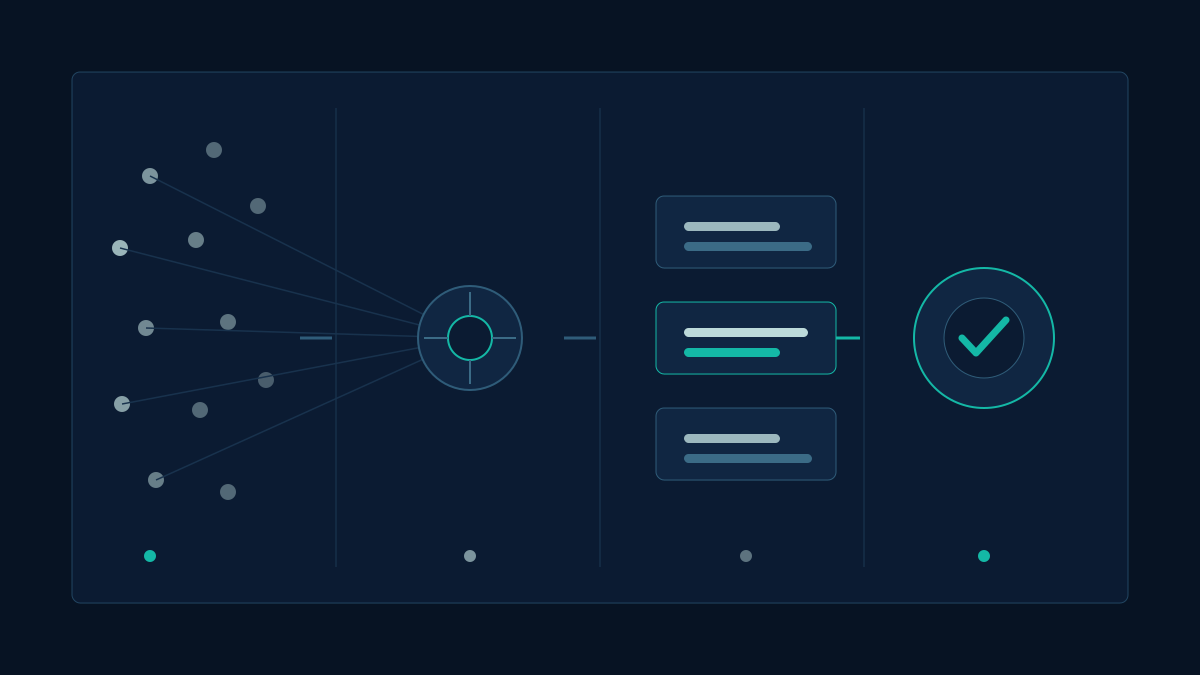
Modern MRP systems are very good at detecting exceptions. Every planning run surfaces shortages, excess, past-due orders, exception messages, and reschedule signals. The harder problem is not detection. It is deciding which of those exceptions actually matter, why they matter, what options exist, and what a planner should do next.
Most planning teams do not suffer from a shortage of signals. They suffer from an abundance of them. The gap between a long exception list and a confident, well-reasoned decision is where planning intelligence has to do its work. Turning MRP exceptions into decision intelligence means treating each exception not as an alert to clear, but as the starting point of a short, explainable reasoning process that ends in a human decision.
The Business Problem
The difficulty is rarely that exceptions go unseen. It is that they arrive faster than they can be reasoned through, and without the context needed to act well. A worklist that grows every cycle quietly pushes planners toward clearing items rather than understanding them.
- High exception volume, where a single planning run can generate more messages than any planner can realistically review each cycle.
- Equal treatment of unequal risks, where a minor timing exception and a genuine customer-impacting shortage look almost the same in the worklist.
- Fragmented root-cause analysis, where understanding a single exception means opening several transactions, screens, and reports.
- Disconnected demand, supply, inventory, and capacity context, so the full picture behind an exception is never in one place.
- Manual prioritization that depends heavily on individual planner experience, memory, and availability.
- Difficulty translating operational signals into decisions that leadership can understand, weigh, and support.
From Signal to Decision
The shift that matters is from listing exceptions to reasoning about them. A useful way to picture this is as a short pipeline that each meaningful exception can pass through: planning signal, then business context, then root-cause explanation, then risk and impact, then response options, then a prioritized recommendation, and finally a human decision.
Each step adds something a raw exception message does not have. Business context connects the signal to the customer, product, or program it affects. Root-cause explanation replaces guesswork with a traceable reason. Risk and impact separate the exceptions that threaten service or cost from the ones that can wait. Response options make the trade-offs explicit. The prioritized recommendation proposes a course of action, and the human decision keeps accountability where it belongs.
This is deliberately more than another dashboard, and more than a chatbot placed on top of planning data. A dashboard shows the state of things but leaves the reasoning to the planner. A conversational assistant can answer questions but does not necessarily produce a governed, prioritized recommendation tied to the underlying planning logic. Decision intelligence is the connective work in between: turning a detected signal into a defensible recommendation a planner can accept, adjust, or reject.
A Synthetic Example
Consider a fictional example built only to illustrate the reasoning. A finished product is flagged with a projected shortage in three weeks. On its own, that is one line in an exception list. Passed through the pipeline, it becomes a decision worth discussing.
The business context shows the shortage affects a product tied to a key customer commitment. The root-cause explanation reveals it is not a single issue but a combination: demand for the item rose after a recent forecast change, a component supplier confirmed a delay on the next inbound shipment, and on-hand inventory is lower than usual because a safety stock buffer was drawn down in an earlier cycle. The risk and impact step estimates that, left alone, the shortage would put part of an upcoming customer order at risk.
The response options then become explicit rather than implied. The team could expedite the delayed component and accept additional freight cost. It could partially reallocate existing inventory from a lower-priority order. It could adjust the production sequence to build what is possible now and follow with the remainder once the component arrives. Each option carries a trade-off in cost, service to another customer, or schedule disruption. Presented together, with the reasoning visible, the planner can weigh them and choose, rather than reconstruct the whole situation from scratch.
Explainability and Governance
For this to be trustworthy in a planning organization, the reasoning has to be as governable as the recommendation. A recommendation a planner cannot inspect is not an improvement over a raw exception list; it is simply a different kind of black box.
- Visible reasoning, so a planner can see how a recommendation was reached, not only what it is.
- Challengeable assumptions, so the demand, supply, and inventory inputs behind a recommendation can be questioned and corrected.
- Attention to data quality, since a recommendation is only as sound as the master data and signals beneath it.
- Confidence treated as confidence, not certainty, with the limits of an estimate stated plainly.
- Human approval as the point of decision, so the system proposes and the planner disposes.
- Decision traceability, so it is possible to review later why a given choice was made.
- No autonomous changes to the plan, because recommendations inform decisions rather than silently rewrite them.
Closing Perspective
It is tempting to measure AI in planning by how much it can summarize: how many exceptions it can condense, how quickly it can generate a narrative. That is the wrong scorecard. The volume of exceptions an assistant can describe says little about whether the resulting decisions are any better.
The more useful measure is the quality, transparency, and governability of the decisions that follow. Planning organizations do not need help producing more signals. They need help moving from high volumes of MRP exceptions to explainable, prioritized, human-governed decisions, with the reasoning intact and accountability clearly held by people. That is the practical promise of decision intelligence, and it is a natural extension of good planning discipline rather than a replacement for it.
A Note on Scope
This article reflects my independent professional exploration. Examples are conceptual or synthetic and do not use employer, client, or confidential data.
Want to discuss explainable decision intelligence in supply-chain planning?
I am happy to connect on MRP exception prioritization, planning governance, SAP planning architecture, and human-governed AI decision support.